A technical study of product-to-engineering handoffs
From a feature idea to a shared agreement.
How structured requirements, source-linked AI assistance, revision-bound approvals, and durable automation connect a product idea to an implementation brief that both teams have reviewed.
Part I / Product intent
Make the agreement explicit.
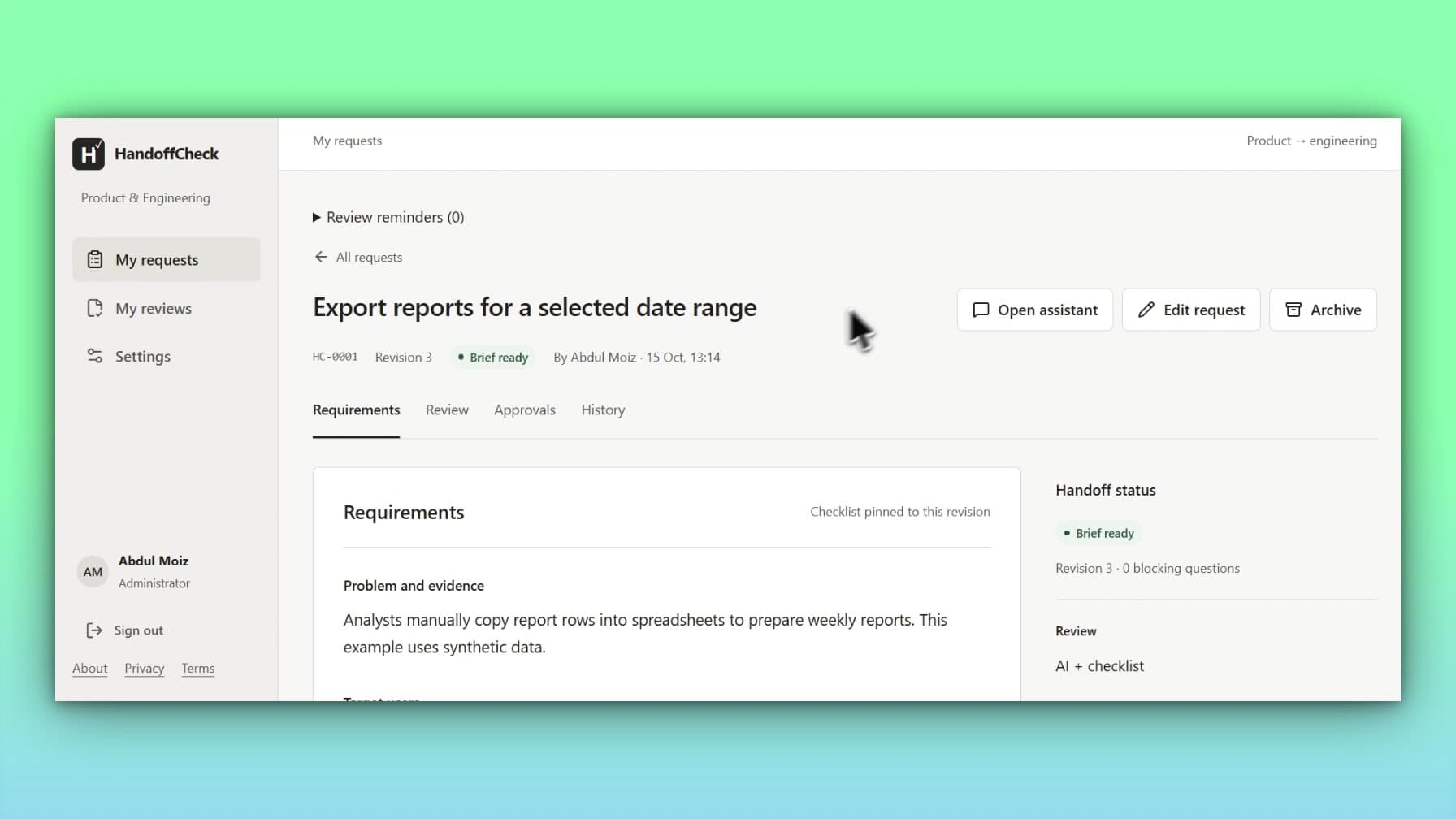
A feature request can look complete while leaving engineering to guess who can use it, what happens on failure, or which behavior is actually in scope. Questions and decisions spread across chat, documents, and meetings. HandoffCheck brings requirements, clarification, reviewer decisions, and the final implementation brief into one workspace.
An author captures a request, selects a product lead and an engineering lead, and submits a revision for review. Deterministic checks and optional AI assistance identify missing details and ambiguous wording. Both assigned leads must approve the same reviewed revision before a brief can be generated.
| Participant | Responsibility | Product outcome |
|---|---|---|
| Author | State the problem, behavior, scope, criteria, and reviewer assignments | An inspectable requirements revision |
| Product lead | Review the intended behavior and resolve product questions | An explicit decision on the current revision |
| Engineering lead | Review the handoff and its acceptance criteria | An explicit engineering decision and reviewable QA drafts |
| Administrator | Manage membership and workspace configuration | The right people and integrations are available |
Part II / System architecture
One application, several clear boundaries.
The interface uses React, Vite, and TypeScript, with React Router for screens, TanStack Query for remote state, React Hook Form and Zod for forms and validation, and Radix primitives for selected accessible controls. Vercel hosts the web application. Electron provides a Windows shell over the hosted workspace.
Supabase supplies Google authentication, PostgreSQL, private object storage, and Deno Edge Functions. Shared TypeScript contracts express requirements, findings, approvals, jobs, and command payloads. Edge handlers verify the current user and route commands into database transactions or bounded provider operations.
| Layer | Owns | Boundary |
|---|---|---|
| Web / desktop interface | Drafting, review, source inspection, briefs, and settings | Browser state does not grant approval or database authority |
| Edge API | Verified commands, provider requests, file checks, and integration coordination | Secrets stay in server configuration |
| PostgreSQL | Participant access, revisions, approvals, jobs, and immutable brief records | Transactions resolve conflicting updates |
| External services | Gemini language tasks, configured Google workflows, Gmail, and Linear | Each integration has its own consent, configuration, and failure behavior |
Part II / System architecture
A request is a structured contract.
An incomplete idea can be saved privately as a draft. Submission requires the baseline engineering checklist, including the problem and evidence, target users, expected behavior, scope and exclusions, testable acceptance criteria, edge cases, dependencies, data and permissions impact, success measure, and priority rationale.
| Field group | Purpose |
|---|---|
| Problem, audience, and evidence | Explain who needs the change and why |
| Behavior, scope, and exclusions | Describe the flow and its agreed boundaries |
| Acceptance criteria and edge cases | Make expected outcomes observable, including relevant failure cases |
| Dependencies and data impact | Expose constraints and permission changes |
| Success, priority, and scheduling | Record the intended outcome, rationale, and an explicit date/timezone or unscheduled state |
| References, files, and assigned leads | Retain supporting material and identify the two reviewers |
The declared contract limits acceptance criteria to twenty, links to ten, and reviewed text to 24 KB. Screenshots and PDFs are private supporting files, with a five-file and 5 MB-per-file limit. Reference URLs are validated but are not fetched for AI review; attachment contents are not sent to the language model.
Part III / Assisted requirements
Start with a conversation. Confirm the form.
The drafting assistant accepts the author's description, proposes structured fields with verbatim evidence from author messages, and asks at most one clarification question per turn. Optional choices explain their tradeoffs. A recommended choice remains a proposal until the author selects it or supplies another answer.
The author checks the preview, applies it to an editable form, selects both leads, and explicitly saves or submits. Conversation output cannot create a request, assign reviewers, or approve a revision. If creation succeeds but submission fails, the saved draft opens with the failure instead of encouraging a duplicate request.
| Intake boundary | Implemented behavior |
|---|---|
| Input | Up to forty messages, 3,000 characters each, 46 KB total |
| Source evidence | Quotes must occur in an author message at the stated index |
| Response recovery | A UUID idempotency key can recover the same response without another provider attempt |
| Draft memory | Author/workspace-scoped response receipts expire after twenty-four hours |
| Consent to requirements | The author explicitly confirms proposed wording through the form |
The input transcript is not stored in the receipt. The validated response can contain quoted author text, and the conversation remains in component memory while the user is drafting. Reusing a receipt requires matching actor, workspace, input prefix, policy version, and lifetime.
Part III / Assisted requirements
Build context for the task at hand.
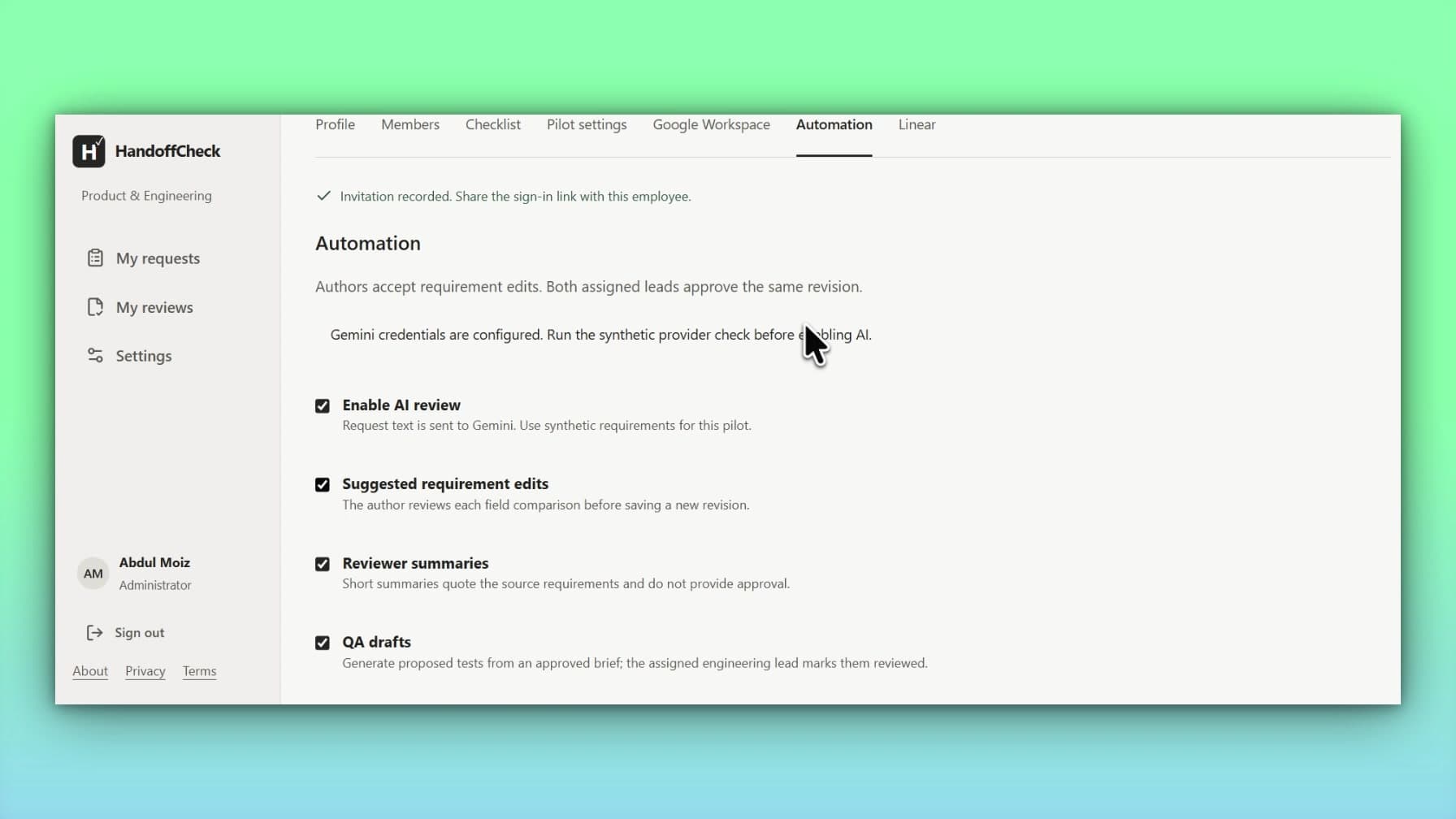
Drafting, requirement review, edit proposals, reviewer summaries, and QA use one Gemini adapter with separate task contexts. The server supplies the model identifier through GEMINI_MODEL_ID; the code does not require a universal default model. Calls use structured JSON output and independent Zod/domain validation.
| Order | Context layer | Purpose |
|---|---|---|
| 1 | Role and goal | Define the selected specialist task |
| 2 | Constraints | Require source evidence and keep permissions and approvals outside model output |
| 3 | Guidance and authorized source | Select up to three versioned guidance chunks and the current task's source |
| 4 | Illustrative example | Demonstrate the required shape without introducing feature facts |
| 5 | Active task and schema | Specify the requested result, evidence rules, and JSON fields |
Older assistant dialogue is compacted while author statements are preserved. Review and QA retain the full source revision and original criterion indexes. A serialized provider request exceeding 120 KB fails before network access rather than dropping source facts. This is task guidance retrieval, not a vector search over company documents.
Part III / Assisted requirements
Keep questions beside their source.
A review first applies required-field rules in code. Optional language review can identify missing details, ambiguous behavior, conflicts, and potential implementation risks. Findings carry the source field, preserved quote, severity, explanation, and clarification question.
The adapter bounds output size and finding counts, verifies field references, and checks source quotes. Missing-detail findings can have empty evidence where the contract permits it. Unresolved blocking findings prevent approval. Leads can dismiss an AI finding with a reason; missing mandatory fields require an updated revision.
Answers become part of the agreement only after the author incorporates them into requirements and submits the updated revision. The assistant's activity feed shows task status, actor, revision, source inspection, prior responses, and sanitized errors. Personal Clear chat affects only that member's browser view; reviews, approvals, and source records remain available.
Part IV / Decisions & persistence
Two people approve one exact revision.
Every successful content save appends an immutable revision containing requirements, attachment metadata, reviewer assignments, checklist version, and canonical input hash. Changing files or assigned leads also changes the revision. Comments and personal interface preferences do not.
Approval requires two distinct active leads in the appropriate roles, neither of whom is the author. Save, review, approval, and brief generation are serialized through transactions on the same request. The database rechecks current assignment, membership, role, revision, and review before accepting a decision or generating a brief.
| Event | Effect on the agreement |
|---|---|
| Save revised content | Create a new author-only draft that needs resubmission and review |
| Replace the current review | Invalidate current approvals before a brief is generated |
| Lead requests changes | Require a new revision and successful review before approval resumes |
| Reviewer reassignment or revocation | Remove prior participant access and recheck decision eligibility |
| Generate a brief | Preserve one immutable artifact for that reviewed revision |
Part IV / Decisions & persistence
Access follows participation.
Google sign-in establishes identity; active workspace membership establishes application access. Drafts are visible to their author. Submitted requests are available to the author and the two currently assigned active leads with the matching roles. Administrators manage settings and members without automatic access to request contents.
The canonical participant predicate is applied to database policies and command paths, including request reads, writes, attachments, comments, findings, approvals, briefs, AI artifacts, notifications, and integration previews. Reassignment, role changes, and membership revocation are checked against current state.
| Record | Retained responsibility |
|---|---|
| Requests and revisions | Current state plus immutable revision snapshots |
| Reviews and findings | Evidence, questions, outcomes, and the reviewed input |
| Approvals and briefs | Human decisions and their deterministic output artifact |
| Jobs and usage | Durable attempts, leases, state, quotas, and filtered context metadata |
| Files and connections | Private references and separately authorized integration state |
Part V / From agreement to delivery
A brief preserves the approved wording.
Brief generation uses a deterministic template over the approved fields rather than asking the model to rewrite the agreement. The result includes requirements, scope and exclusions, criteria, dependencies, data impact, references, revision/hash, and the two approval records. Users can read it in the app, copy Markdown, or download it.
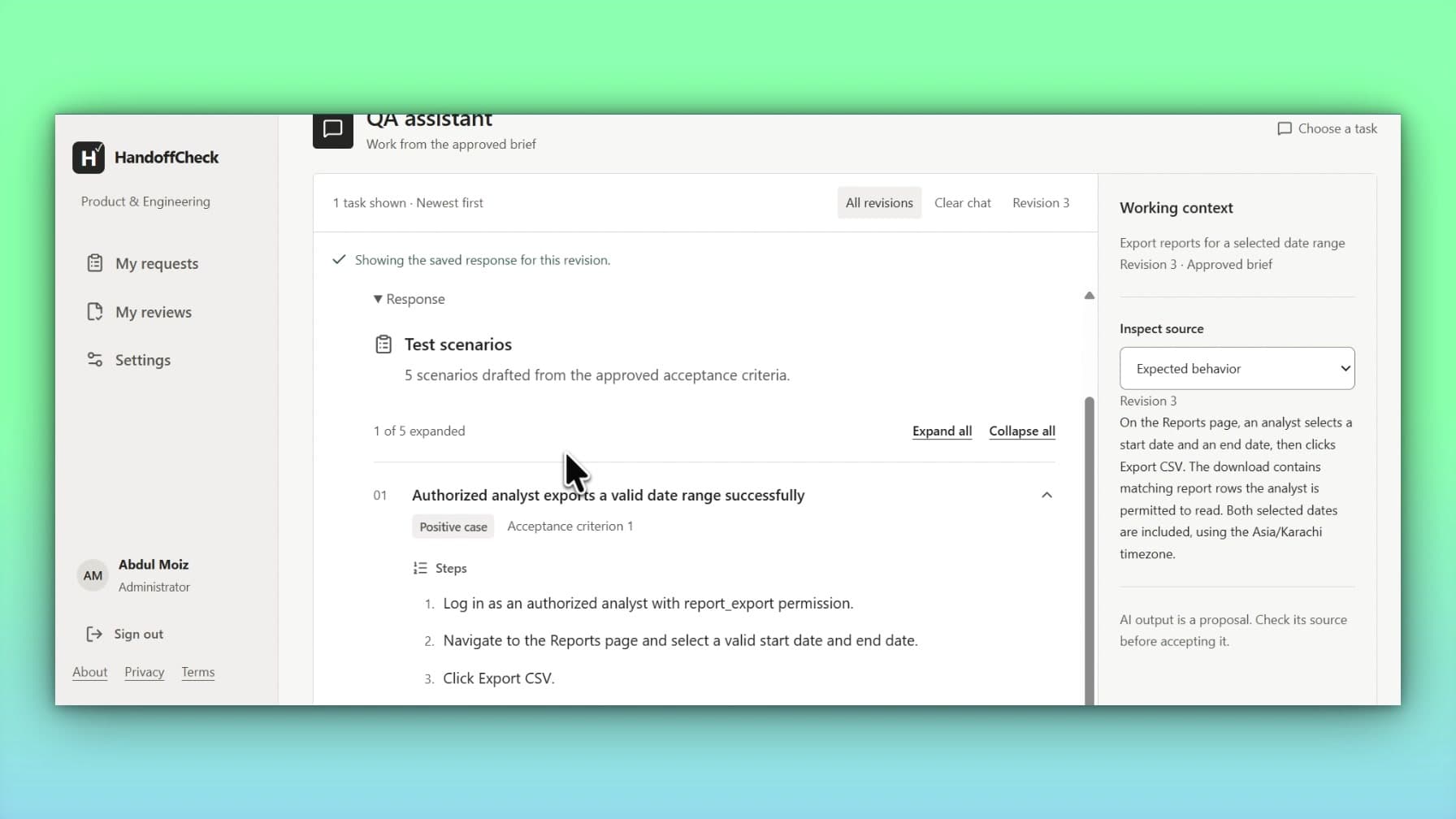
The QA assistant then drafts scenarios from that approved snapshot. Every scenario references a real criterion index and quote, with steps and expected results. Supported positive, negative, boundary, and permission cases are presented for inspection; the assigned engineering lead reviews the draft.
Part V / From agreement to delivery
Make background work observable.
Provider tasks are stored before dispatch with bounded leases and attempts. Each claim rechecks access, revision, policy, and budget. A stale result remains historical and cannot advance a newer source revision. The interface distinguishes queued, working, retry-pending, and failed states.
| Operation | Bound or recovery behavior |
|---|---|
| AI usage | Initial allowances of ten attempts per actor/hour, fifty per workspace/day, and two concurrent calls |
| Provider call | Twenty-five-second timeout and bounded structured output |
| Transient review failure | At most three total attempts with scheduled thirty- and sixty-second eligibility delays |
| Invalid output or access/configuration failure | Visible failure requiring deliberate retry |
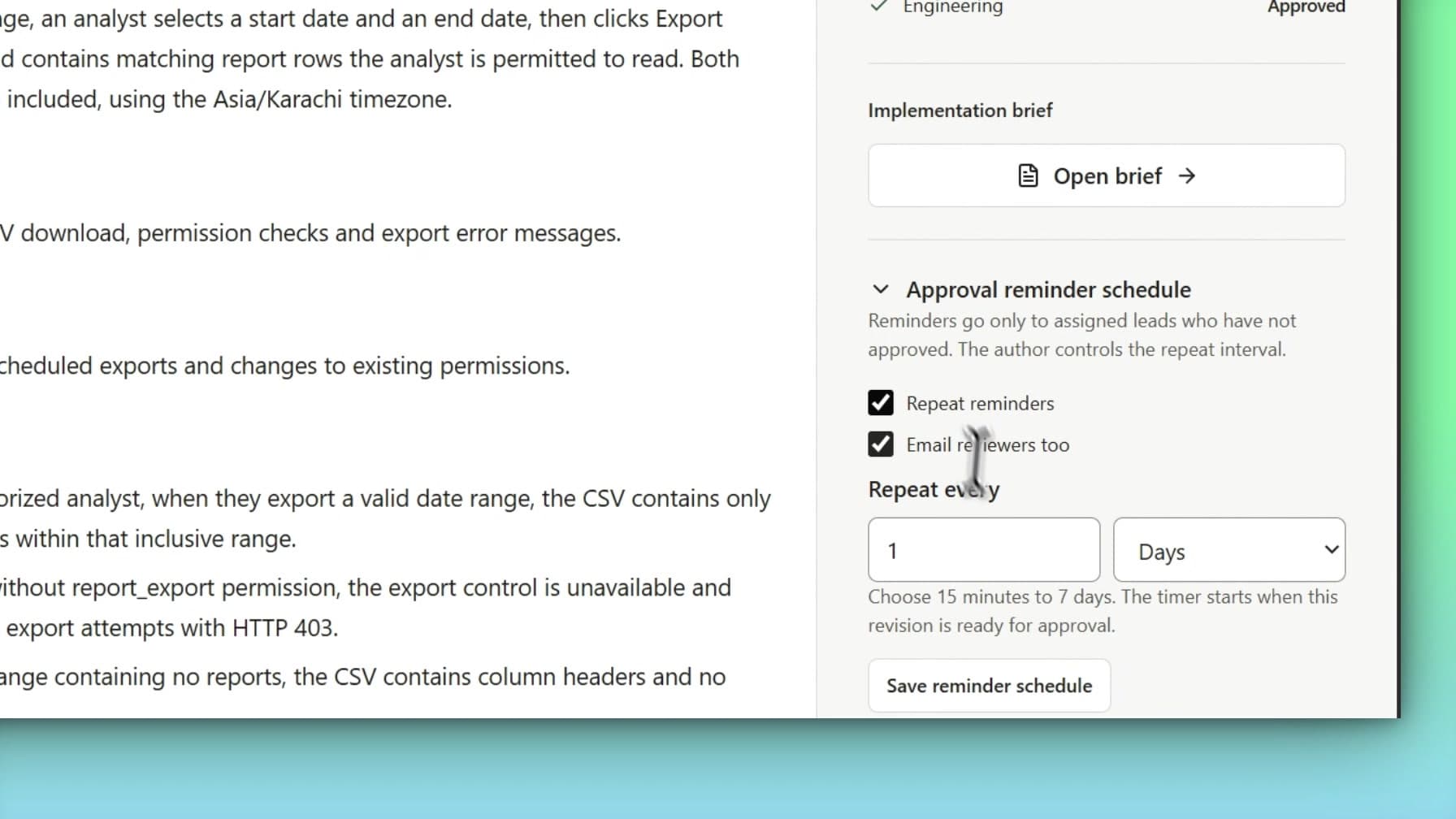
| Approval reminders | Author-set interval from fifteen minutes to seven days; only active pending leads are selected |
| Ambiguous Gmail send | Delivery unknown; no blind resend in the same cycle |
Reminder timers follow the current revision and approval state. Clarification, a new draft, completed approval, archive, or pause suspends or stops the schedule. Optional email uses the author's separately connected Gmail identity. Private credentials and PKCE state remain server-side, and dispatch checks the current connection generation.
Part V / From agreement to delivery
Connect the team's existing tools.
| Connection | Workflow | Explicit boundary |
|---|---|---|
| Google Workspace | Configured Forms intake through Sheets into requests, followed by approved Docs export | Owner-operated Apps Script, signed bridge requests, and Google file-sharing controls |
| Gmail | Optional author-authorized approval reminders | Separate consent, encrypted server credentials, and delivery uncertainty tracking |
| Linear | Preview and explicitly confirm a handoff of approved work | Configured destination and backend credentials required |
| Windows app | Electron loads the hosted workspace and signs in through the system browser | Requires internet access; packaged delivery has separate release/signing configuration |
App-created requests are excluded from automatic Google Sheet mirroring and Doc export; Form-origin requests use their configured Google pipeline. Bridge signatures, nonce replay checks, owner membership, artifact hashes, and export acknowledgements protect the integration path. External destinations retain their own access policies.
Part VI / Verification & tradeoffs
Test the workflow at its boundaries.
The project includes application/provider tests, database tests against PGlite with Supabase Auth/Storage substitutes, native authentication tests, and browser workflows. These exercise domain transitions, participant policies, stale revisions, source evidence, job recovery, quota behavior, and narrow-screen interaction.
| Boundary | Useful verification |
|---|---|
| Requirements | Incomplete drafts remain editable; mandatory gaps block submission or approval |
| Evidence | Invalid quotes, fields, criterion indexes, and oversized outputs are rejected |
| Decisions | Two different assigned leads approve the same revision; concurrent saves cannot reuse old approvals |
| Access | Authors, current leads, unrelated members, and administrators receive the correct view |
| Recovery | Lost responses, expired leases, provider failures, and new revisions preserve consistent state |
| Integrations | Consent, signing, replay, disconnect, and ambiguous delivery are tested separately |
Synthetic provider tests verify contracts and failure handling; they do not establish live model wording quality. PGlite tests do not replace checks against a running Supabase installation. Real Google consent, external delivery, account configuration, and independent security review require their own evidence.
- Keep product facts, model suggestions, and human decisions distinguishable.
- Preserve the source revision through reviews, approvals, and exported artifacts.
- Use transactions for decisions that must agree under concurrent updates.
- Make provider errors, retries, and ambiguous external outcomes visible.
- Evaluate assistant usefulness with representative requirements and reviewer feedback before claiming productivity gains.